

New Programme Focuses On First Aid And Child Safety
Creating a safer school environment for the more than 150,000 students attending Early Childhood Care Centres and Primary Schools across Trinidad and Tobago is the aim of a new initiative launched recently in South Trinidad.
According to regional public health tracking data published in 2025, the Caribbean has experienced the largest increase in unintentional child injury incidents compared to other regions over the past few decades.
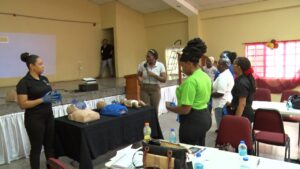
Two local organisations are addressing this trend by launching a new initiative. In conjunction with the Lotus Medical Centre, Advanced EHS Concepts Limited hosted their first Safe Schools – Strong Futures First Aid Community Initiative in Fyzabad.
Advanced EHS’ Health, Safety and the Environment Consultant, Samantha Cato, highlighted some of the common health and safety hazards.
« Common school hazards, and we just want to look at a few common hazards in Trinidad and Tobago. Alright, so on the playground, playground and pitch, persons can experience or children can experience falls from monkey bars, unpaved terrain, scrapes, sprains, impact concussion. »
She noted that this is just in the playground and turned to instances in the classroom.
« Classroom environment: craft scissors, heavy equipment, wet tile floors during rainy season, small swallowed objects. What about in the cafeteria? What about snacks that they put in the lunch boxes? Food allergies, choking hazards, hog food spills. »
Meanwhile, the Lotus Medical Centre’s family care physician, Dr Jaedan Chablal, shared what educators need to look for to keep their young charges safe.
« They would have very minor changes to their behaviour, so they come to school, you find they are not as they usually are; they’re sleeping away all the time and they’re usually awake and alert in class, or they’re confused, they’re agitated, they are a completely different person. All of these things are very, very concerning, especially if they happen in a short time frame. Apart from that, breathing is perhaps one of the most concerning things in children when children are in respiratory distress. »
Dr Chablal stressed that changes in breathing should never be ignored.
« Any very fast, noisy breathing, you know, kind of like wheezing, you see that they are sucking in where their ribs are, and especially if they can’t finish a sentence without having to take a breath. That’s very concerning as well. »
The initiative targeted teachers and staff at the Early Childhood Care and Primary School levels.